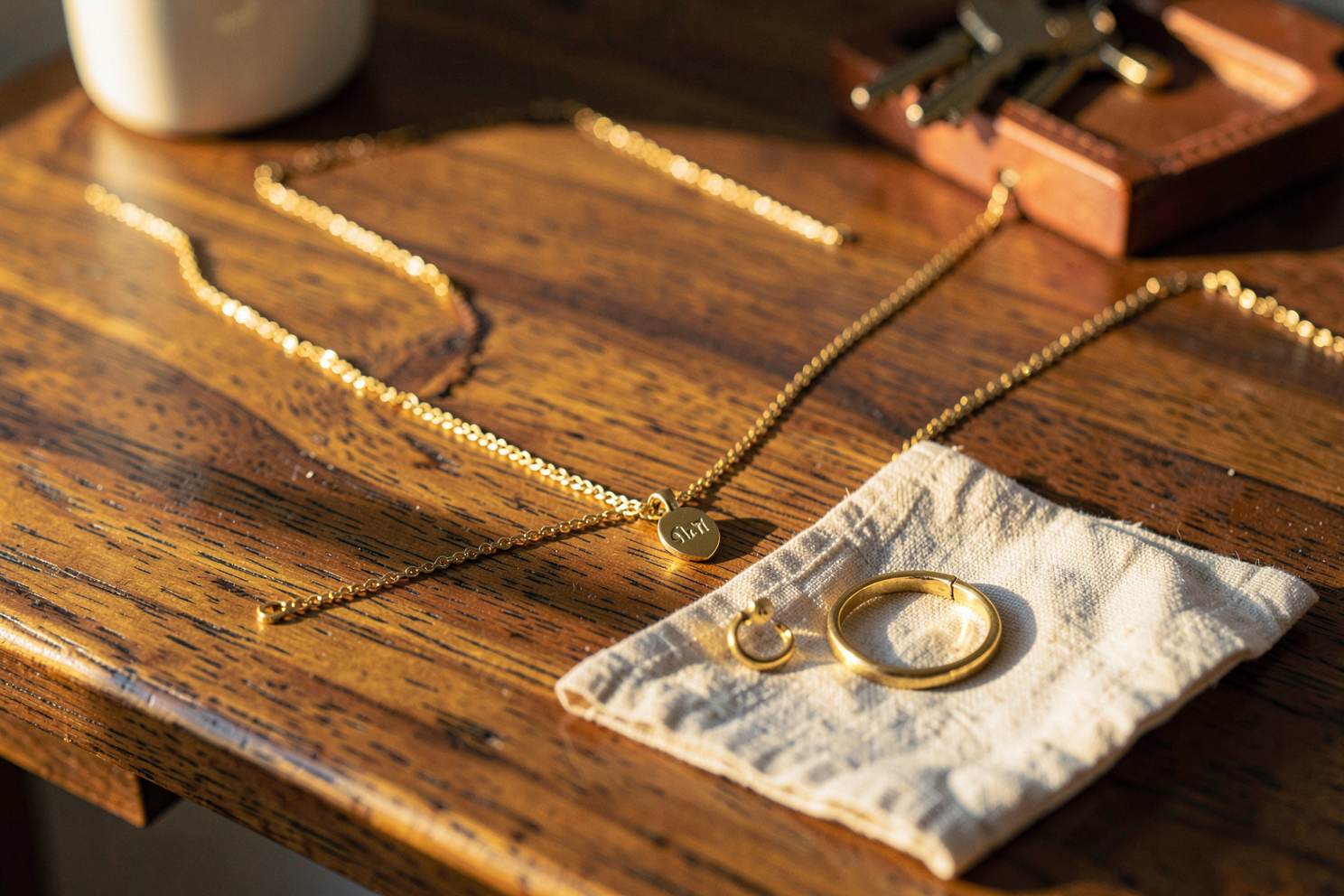
Three pieces. One thin chain, one pair of small earrings, one thin ring. That's the whole stack, and the number is the point — it's the count where a stack still reads as one calm layer instead of a pile.
I don't have purchase records for gold jewelry. My seven years of testing and returning products is all home organization, so treat this as the editorial formula, not a haul. What I can tell you is the shape of it, and the shape is what people get wrong.
Why three, and not five
Three is where the stack stops being a decision.
A chain, a pair of earrings, and a ring cover three separate zones: neck, face, hand. They don't compete for the same space, so nothing has to be moved or adjusted during the day. Add a fourth piece and you start matching. Add a fifth and you're styling, which is a different activity than getting dressed.
The failure mode isn't ugliness. It's friction. A stack you have to think about is a stack you stop wearing by week three.
Pick one tone and stay there
Warm gold, all of it, or the stack looks borrowed.
Mixing yellow and white gold works when it's deliberate and heavy. At three thin pieces it just looks like two different outfits. If your closet is warm neutrals — oatmeal, camel, cream, olive — yellow gold disappears into it in the good way. If it's cool greys and blues, white gold or platinum-toned metal does the same job.
The one exception worth making: a two-tone watch, if you already wear one daily. Then both metals have a reason to be there.
What "everyday" actually requires
Everyday means shower, commute, sleep, gym-adjacent, dishes. That rules out a lot of jewelry people buy for the look.
Two things matter. First, metal that won't react with your skin — 14K and up, or a solid gold-filled piece with a real thickness of gold bonded to the base. Gold plating measured in fractions of a micron will wear through at the clasp and the ring band first, usually within a year. Second, closures that don't need a mirror. A lobster clasp you can work by feel beats a tiny spring ring you can't.
If a piece has to come off before you shower, it isn't in the stack. It's in a drawer.
The length difference is the whole trick
For a two-chain look, the gap matters more than either chain. 40cm and 45cm is the pair that works on most people — the shorter one sits at the collarbone, the longer one drops just below it, and the 5cm gap keeps them from tangling into each other.
[NEED: a specific chain I've worn and its actual length, or cut this section's first-person framing]
Anything under a 3cm gap and they'll twist together within an hour. Anything over 8cm and it stops reading as a stack and starts reading as two necklaces.
If you only wear one chain, skip this entirely. One chain at 42–45cm is the single most wearable piece of jewelry I can describe.
The three-piece formula
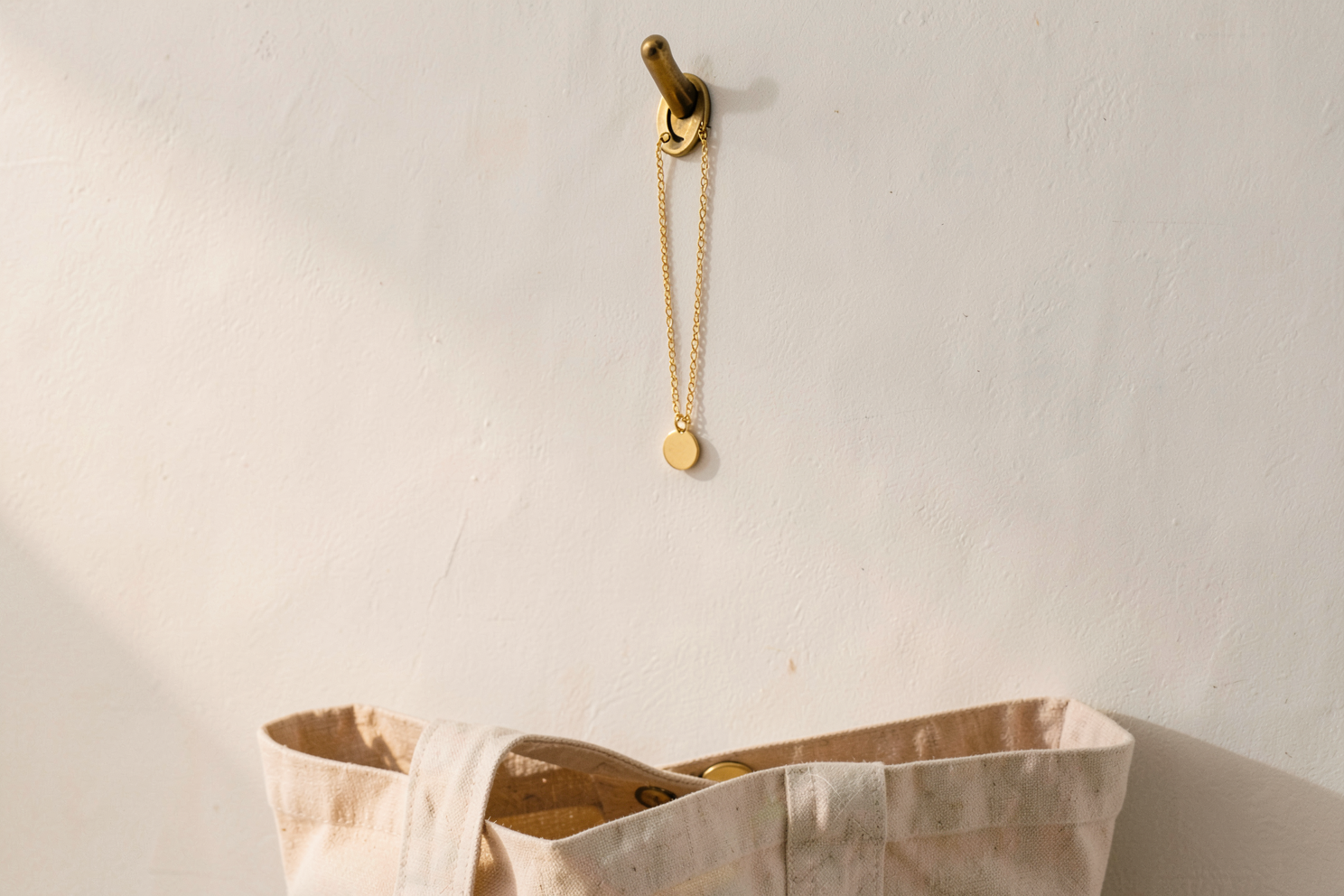
Base layer — the chain. One thin chain, 40–45cm, warm gold, a clasp you can open without looking. This is the piece you'd keep if you could only keep one.
Accent layer — the earrings. Small studs or a thin huggie hoop, under 15mm. Big enough to see, small enough that you forget them. Huggies win if you sleep in your jewelry; studs with a screw-back win if you don't.
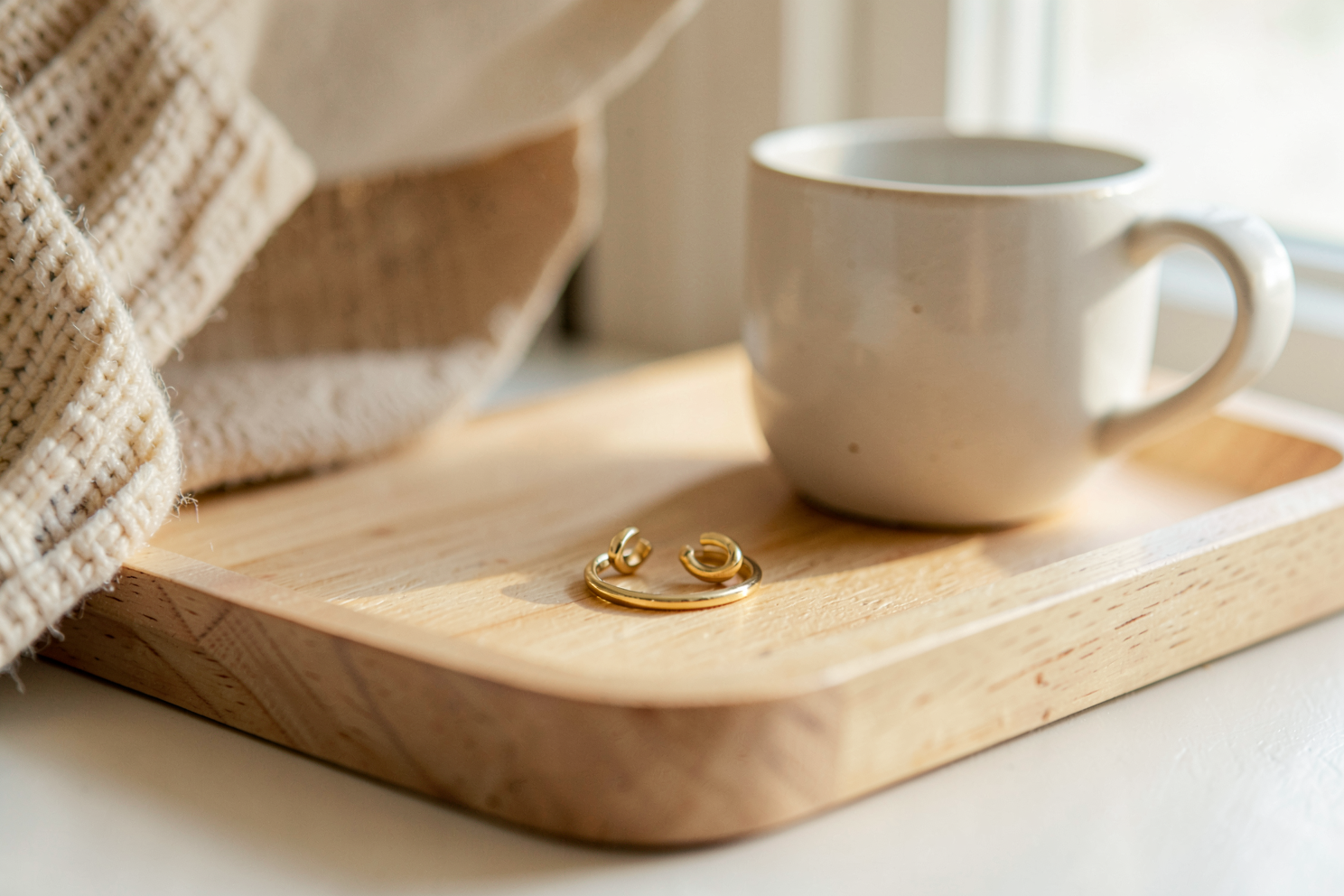
Stack layer — the ring. One thin band, 1–1.5mm, worn alone on the index or middle finger or stacked with your wedding set. Thin is what makes it stackable later without looking crowded.
Search terms that actually return this stuff: "14k gold filled thin chain 45cm", "gold huggie hoops 12mm", "1mm gold stacking ring". Brand-wise, Mejuri and Aurate both sell in this register — Mejuri's thin chain and huggie categories, Aurate's 14K basics. Search "mejuri thin gold chain" or "aurate 14k huggie hoops" and you'll land in the right aisle. Drawback on both: the thin chains are genuinely thin, and thin means they can kink if you sleep in them every night. That's the tradeoff for the look.
[NEED: a specific brand, size, and my own experience with it, if I've bought from either — otherwise keep this as search guidance only]
How do I keep a gold stack from tangling?
Keep a minimum 5cm length difference between two necklaces, and close both clasps at the back rather than the side. Two chains within 3cm of each other will twist together within about an hour of wear. If they still tangle, one of them is too long for your neck — measure your collarbone, not the chain.
Can I shower and sleep in 14K gold?
Yes, and that's the main reason to pay for it. 14K solid gold doesn't tarnish or react with soap and water, so it stays on through showers and sleep. Gold-plated and thin gold-filled pieces will wear at the clasp and band, typically within 6–12 months of daily wear. If you take it off to shower, it isn't everyday jewelry.
Do the earrings and ring have to match the chain?
They should share a tone, not a design. All three in warm yellow gold reads as one stack; mixing yellow and white at three thin pieces reads as two unfinished ones. The exception is a two-tone watch you already wear daily, which gives both metals a reason to be on your body at once.
What to buy first
Buy the chain. One thin 40–45cm chain in 14K or solid gold-filled, warm tone, clasp you can work without a mirror. Wear it alone for two weeks before you add anything. If it survives showers, sleep, and a Tuesday, the other two pieces are easy. If it doesn't, you've learned that in one purchase instead of three.
Then add the earrings, then the ring, in that order — cheapest to replace last, and the ring is the one you'll want to try on in person anyway.