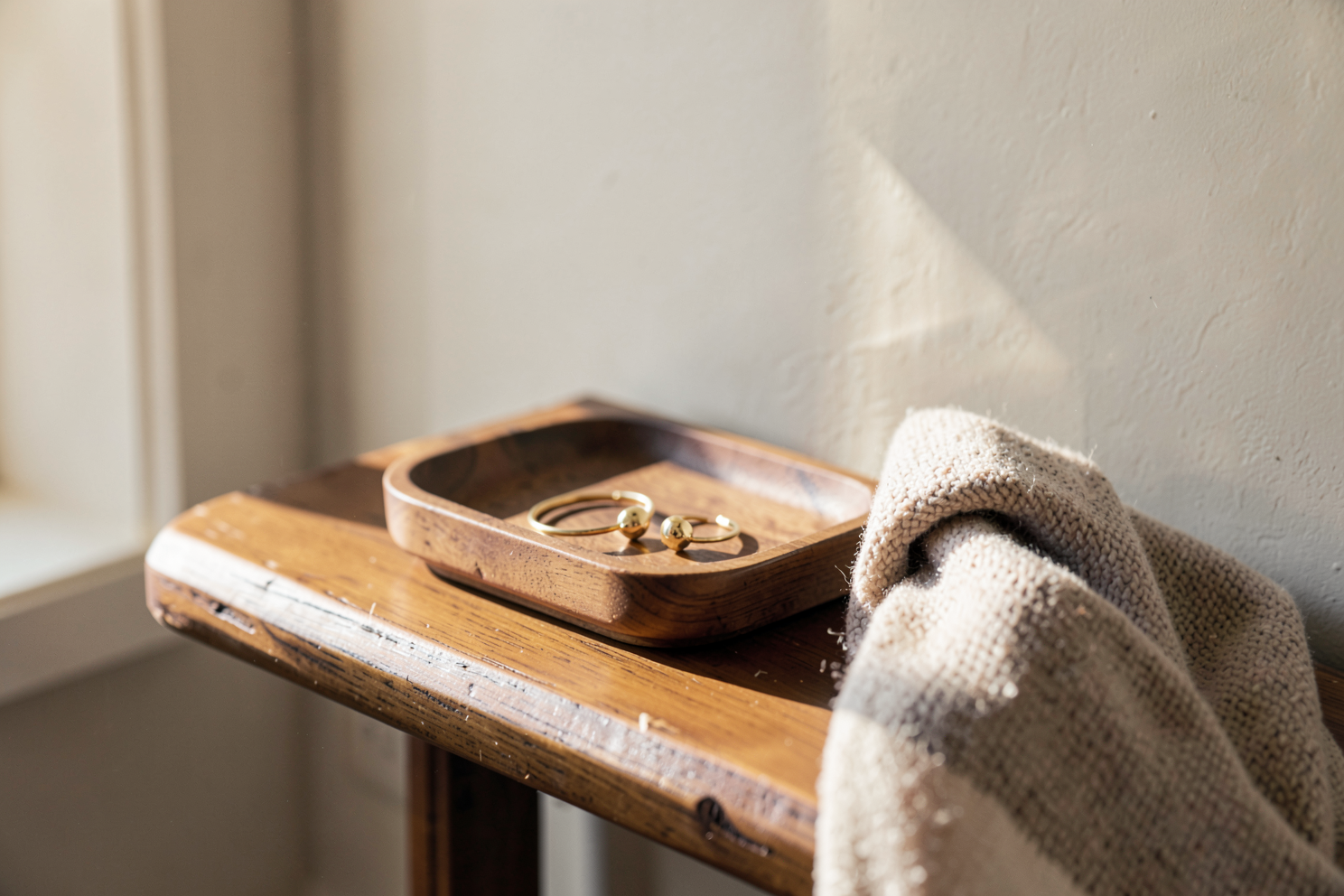
Two studs in the front holes. One hoop on the outside. Same metal on all three. That is the whole formula, and it takes about thirty seconds once the backs are off.
I started wearing it because I got tired of deciding. A full ear curation looks great in photos and takes ten minutes in front of a bathroom mirror, and half the time I took one piece off in the car. Three pieces is enough to read as intentional and few enough that I stop thinking about my ears by 9 a.m.
Why two studs and one hoop, and not five pieces
The studs do detail work; the hoop does shape work. A stud is a small bright point that catches light when you turn your head. A hoop draws an actual line. It makes the ear look longer and gives the whole side of your face a frame. You need both, and you need the hoop to be the only one.
Three is the number where the eye still reads individual pieces. Past four, on a normal-size ear, it reads as texture. That is fine if texture is what you want. It is not what I want on a Tuesday.
The other reason is weight.My everyday hoops are light enough that I forget them, but I have owned hoops that pulled enough to make the hole sore by afternoon. Two studs add almost nothing. One hoop is the only piece that can ruin your day.
What counts as a stud here
Anything under about 6mm that sits flat against the lobe. A tiny huggie counts. A small charm on a short post counts if it doesn't dangle past the lobe edge. What doesn't count is a second hoop. Two hoops of different sizes in the same ear is a different look, and it is a busier one.
Where each piece goes
Front hole gets the smaller stud. Second hole gets the slightly larger one, or the one with more sparkle. Outside hole, or the helix, gets the hoop.
The reason for that order is proportion. Your lobe is widest at the bottom and the ear narrows as it goes up and out. Putting the biggest element at the outer edge follows the shape instead of fighting it. Putting a big stud in the front hole and a small one behind it makes the front look heavy and the back look like an afterthought.
If you only have two holes, skip the second stud and wear one stud plus the hoop. Do not add a third piercing just to make a formula work.
Keep the metal the same
All gold or all silver. Mixed metals can look deliberate, but it takes a confident hand and usually a third piece to tie it together, and I am not spending my morning on that. If your wedding ring is yellow gold and your favorite studs are silver, pick one for your ears and stay there.
This is where most stacks fall apart. Not the number of pieces. The number of finishes.
Does the formula work outside of work clothes?
Yes, and that is the main reason I keep it. It reads as polished with a button-down, quiet with a knit sweater, and slightly accidental with a weekend hoodie, which is the effect I want on a Saturday.
The trick on casual days is hair. Pull one side back behind the ear and leave the other side down. That gives the stack one clean side to be seen from and keeps the other side from competing with it. A low bun does the same thing. If your hair is short enough that both ears are always visible, you already have this handled.
I do not change the earrings between work and weekend. I change the hair.
What about necklaces
This formula pairs with a single thin chain and nothing else near the collarbone. If you are already stacking necklaces, your ears should be the quiet part. I wrote about the necklace version separately, and the two stacks do not need to run at the same volume on the same day.
The 30-second version, in order
1. Hoop on the outside hole first. It is the piece most likely to need a mirror. 2. Larger stud in the second hole, if you have one. Angle your head down and you can usually do this by feel. 3. Smaller stud in the front hole. This one you can do without looking. 4. Check that all three backs are actually closed. I have lost exactly one earring in seven years and it was because I skipped this step.
That last one is not filler. Earring backs are the whole reason a stack survives a day.
Where this fits with the rest of my jewelry
Once you have a formula, you stop buying earrings you never wear, which means the drawer gets easier too. My rule now is that a new pair has to fit one of the three slots — front stud, second stud, or hoop — or it doesn't come home. That has cut my earring purchases to roughly one pair a year.
If your collection is already past that point, the fix is storage, not more decisions. A felt tray with fixed slots works better than a dish for studs, because studs in a dish become a pile. For hoops, a T-bar stand keeps the pairs together and stops the clasps from tangling.Search "jewelry tray with stud slots" and "T-bar earring stand" — I use a tray and stand I picked up a while back.
One warning on the trays: the cheap velvet ones shed onto light-colored earrings. Mine did. If your studs are silver or white gold, look at the lining before you commit.
How do I keep a stack from looking cluttered?
Cap the total at three pieces per ear, keep every metal the same finish, and make sure no two pieces are the same size. Three pieces in two sizes reads as a stack. Three pieces in three sizes reads as a collection, which is a different thing and a busier one.
Can I wear this with a second piercing that hasn't healed?
No. Leave the healing piercing empty except for the starter stud your piercer put in, and run the formula on the other ear. A hoop in a healing hole is the fastest way to get irritation bumps, and those take weeks longer to settle than the piercing itself took.
What if my ears aren't pierced high enough for a hoop on the outside?
Then put the hoop in your first hole and both studs above it. The formula is about proportion, not hole order — one hoop, two smaller pieces, one metal. Move the hoop wherever it sits best on your ear and adjust the studs around it.
Do I need real gold?
No, but you need something that won't turn your ear green in a week.What I actually wear is some everyday studs, and they've held up fine. Gold-filled and surgical steel both hold up better than plated brass for daily wear, and plated pieces are the ones that go dull first.
Start with what you already own. Take everything out of the dish, lay it on a flat surface, and pick the two smallest studs and the one hoop that match. That is your stack. Wear it for a week before you buy anything.