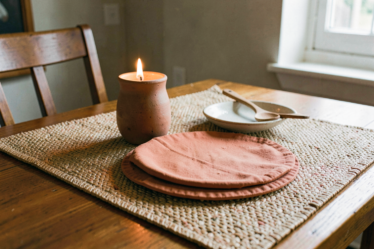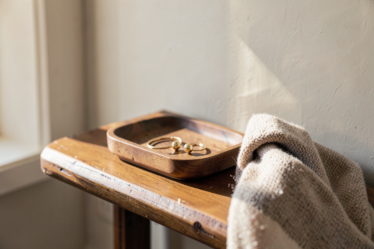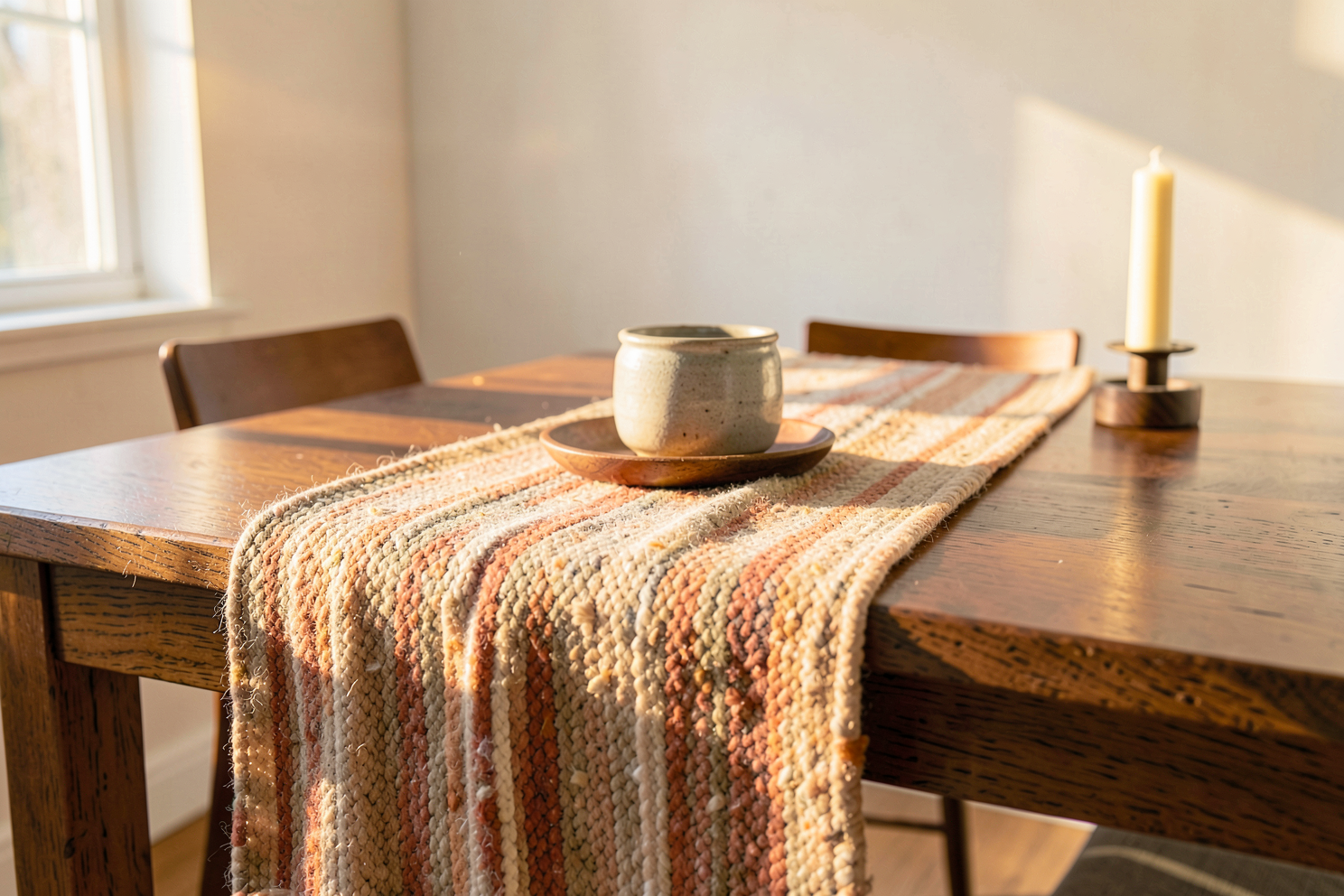
The fastest way to make a dining table look intentional is one woven runner down the middle. No tablecloth, no centerpiece collection, no styling session. One layer, and the table stops looking like a flat surface you eat off and starts looking like a room.
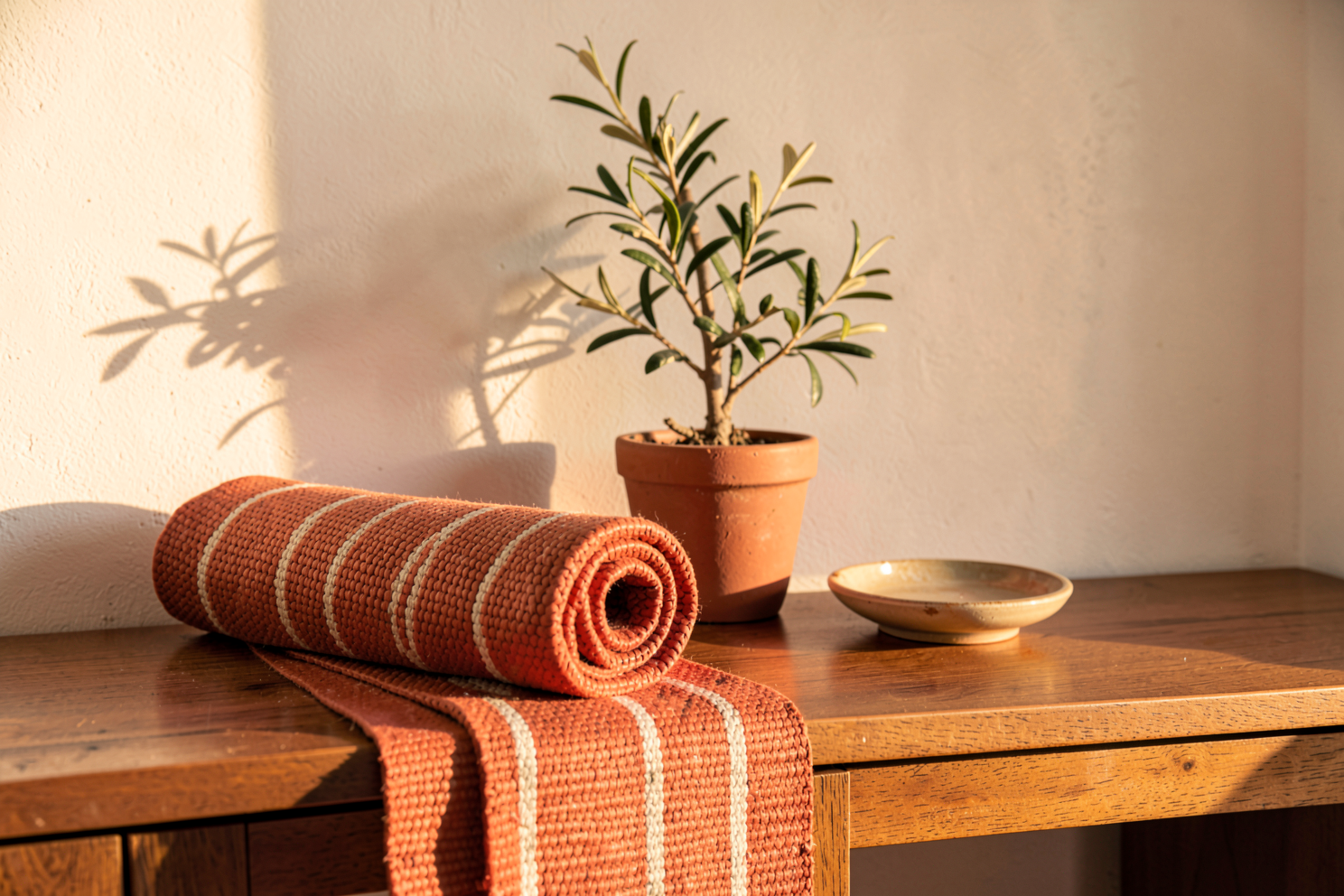
I came to this the lazy way. My dining nook is 8 ft × 9 ft with a round table and four chairs, and every full tablescape I tried looked crowded by the second place setting. A single runner fixed it. It's also the one thing I can roll up and shove in a drawer when the table needs to be a table.
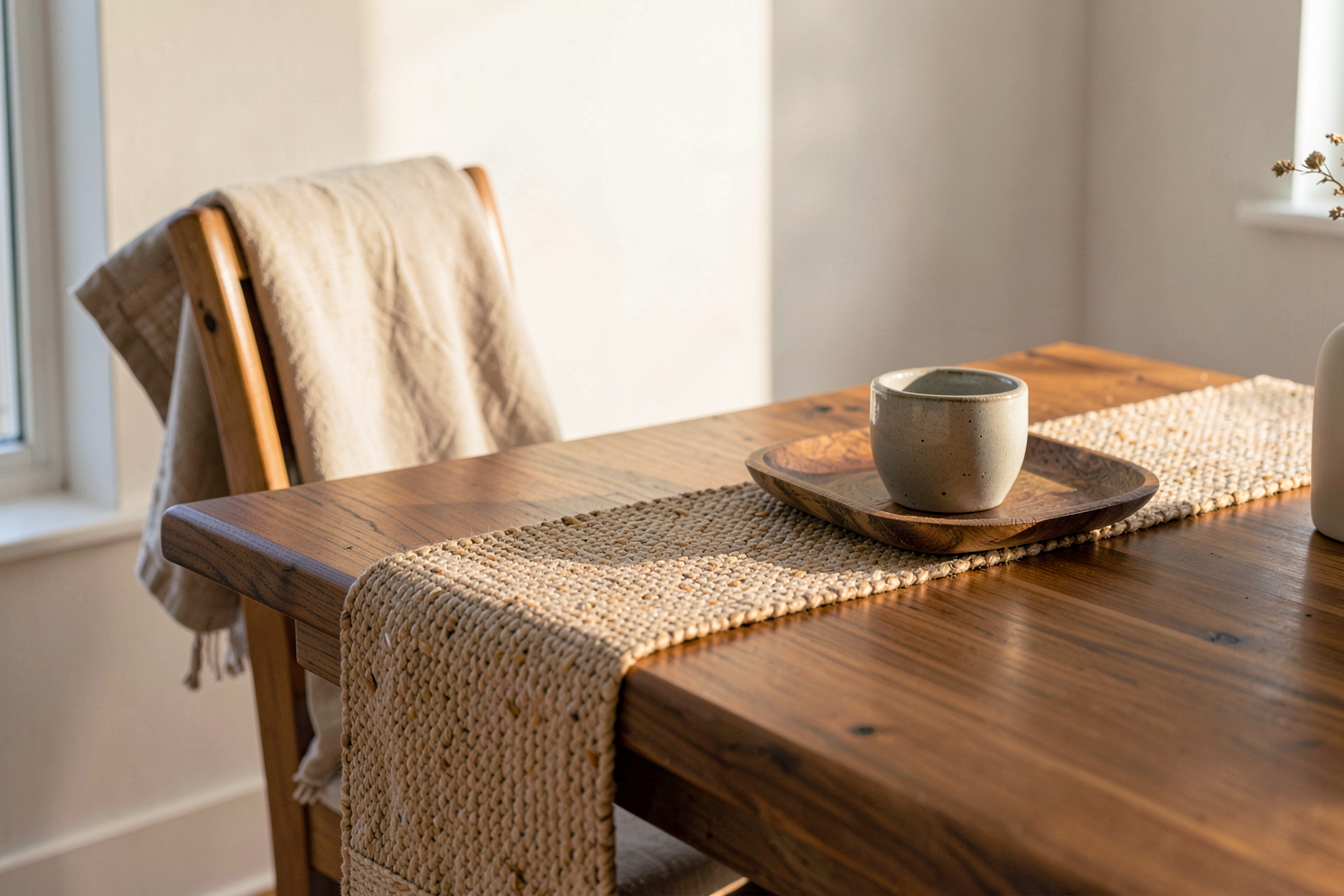
Here's what actually matters: the material, the color, the length, and the one object you put on top. That's the whole system.
Why one layer beats a full tablescape
A single woven runner is easier to live with than a styled table because it survives daily use. A runner takes crumbs, hot plates, and a cat landing on it. A curated centerpiece does not.
Biscuit treats anything on the table as a shelf to knock off. A vase of stems was gone in a week. The runner stays because it's flat. That's not a cute detail. It's the reason the runner is the only table decor in this house that has lasted.
There's a cost argument too. A full tablescape means a charger stack, cloth napkins, a centerpiece, and somewhere to store all of it. A runner is one purchase and one drawer. If you've been buying storage boxes to hold table decor you don't use, you already know the problem.
What color and material should a woven table runner be?
Warm neutrals in cotton or a cotton-linen blend read warmest and hide the most. Oatmeal, caramel, and terracotta are the three that work without fighting your dishes.
Why those three: they sit in the same warm family as wood tones and most dinnerware, so nothing clashes when you swap plates. A cool gray runner on a wood table looks like a mistake. A terracotta one looks deliberate.
Material matters more than pattern. Look for a flatweave or a chunky cotton weave with some weight. Thin, slick runners slide every time someone sets down a plate. You want one that grips the table and stays put. Linen blends wrinkle, and that's fine. It reads relaxed, not sloppy.
Keep the pattern simple. A subtle stripe or a fringe edge is enough. Heavy geometrics compete with your dishes and make the table look busy at a small scale. In an 8 ft × 9 ft nook, busy is the enemy.
How long should a table runner be?
A runner should overhang 15–20 cm (about 6–8 inches) on each end of the table. Any shorter and it looks like it shrank. Any longer and it puddles on the chairs.
Measure your table length, then add 30–40 cm total. My round table is the awkward case. A rectangular runner on a round table works if the overhang is even on both sides, but it will never look as clean as it does on a rectangle. If you have a round table, measure twice and accept a slightly shorter overhang rather than letting it drape onto laps.
Width is the other number people skip. A runner should be about one-third the width of the table. On a standard 36-inch-wide table, that's roughly 12 inches. Wider than that and you've basically laid a narrow tablecloth.
What goes on top of a woven runner?
One object. A tray or a candle holder, not both plus a vase. The runner is the layer; the object is the punctuation.
A shallow tray corrals salt and pepper, a candle, and whatever else wanders onto the table, and it lifts everything off the weave so nothing stains. A single candle holder works if you'd rather keep it minimal. The rule I use: if I can't carry the whole arrangement to the counter in one hand, it's too much.
For a candle, the Auelife scented candle (4.4 stars, $16.99) is the one in my fall decor rotation and it sits fine on a tray. It's a candle. It doesn't solve anything, it just looks right next to a warm runner. Search "auelife scented candle" if you want the exact one.
For the runner itself, a cotton flatweave in oatmeal is the safe first buy. Search "cotton table runner oatmeal" and look for one with a stated width around 12 inches and a length that matches your table plus the overhang. The drawback: cotton flatweaves show oil spots. Treat a stain the same day or it sets.
How do you keep it looking good day to day?
Roll it, don't fold it, and spot-clean fast. A runner stored folded creases along the fold lines and never lies flat again.
Rolling takes ten seconds and stores in a drawer or a basket. That's the whole storage story. No box, no bin, no label maker. (A label on a messy drawer is still a messy drawer. Same logic here: a folded runner with a crease is still a creased runner.)
For daily care: shake it out over the sink after dinner, spot-clean with a damp cloth and a drop of dish soap, and let it air dry flat. Most cotton runners can go in a cold gentle wash, but check the tag. A chunky weave can unravel in a machine.
One warning. Don't put a hot pan straight on the weave. Cotton scorches, and a scorch mark doesn't come out. Use a trivet or set the pan on the tray.
The cheapest first step
Buy one runner before you buy anything else for the table. Measure your table length, add 30–40 cm, pick a warm neutral in a cotton flatweave around 12 inches wide, and put a tray you already own on top. That's the entire setup, and it costs less than a single centerpiece.
If it doesn't work, you'll know in a week, and you'll have spent money on one thing instead of five. That's the difference between decorating and organizing, and it's the difference I keep coming back to.