The fastest fall change in my house takes ten minutes and costs about twenty dollars. I swap two pillow covers. That's it. The sofa stays, the rug stays, the wall color stays.
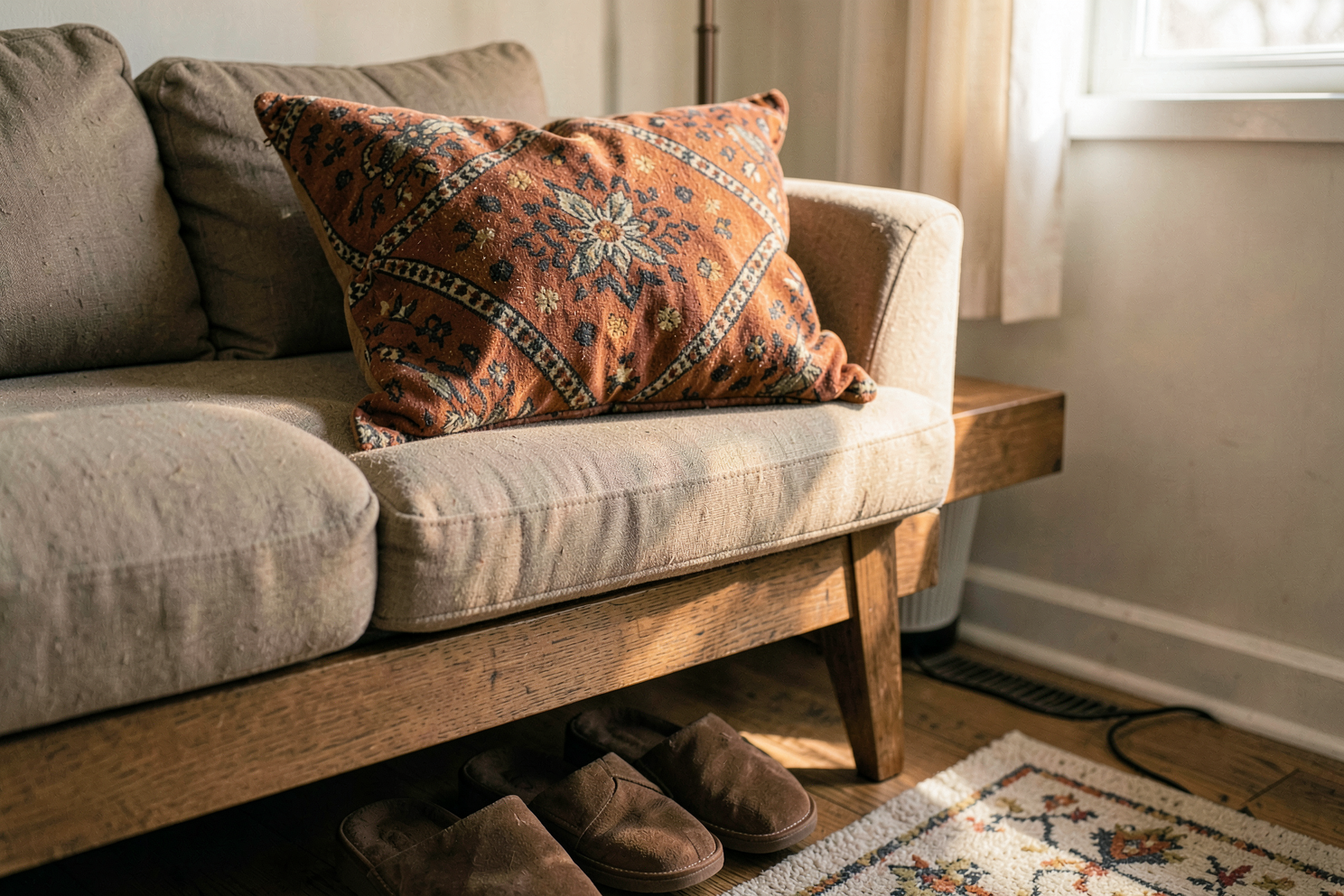
Here's the thing about a beige or oatmeal sofa: it isn't cold, it's just neutral. It reflects whatever you put on it. In summer that's fine. In October it reads a little flat. You don't need a new sofa or a new throw or a seasonal gallery wall. You need two covers in the right color, and the right color for a warm-neutral room is rust.
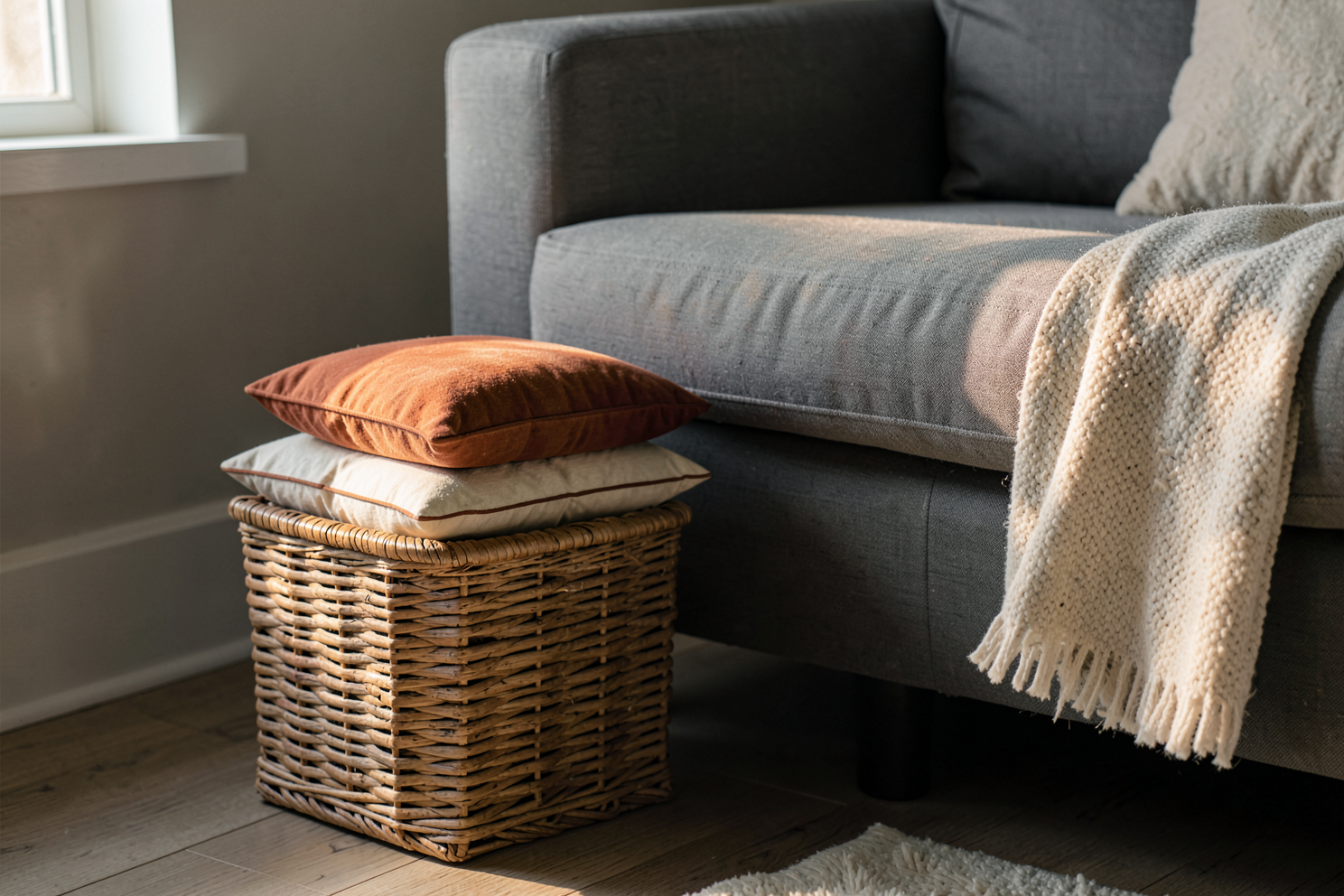
Not orange. Not terracotta-red. Rust, the brown-orange that sits between them. It's the safest autumn color there is, because it already has brown in it, and brown is what your sofa's undertone is doing anyway.
Why rust works on beige, oatmeal, and gray sofas
Rust is a warm color with a brown base, so it never fights a neutral sofa the way true orange or bright red does. On a beige or oatmeal couch it reads as a deeper version of what's already there. On a gray couch it does the opposite job — it pulls the gray warm instead of cool, which is why a lot of people with gray sofas think their living room feels cold and can't figure out why. It's not the sofa. It's that everything on it is also gray.
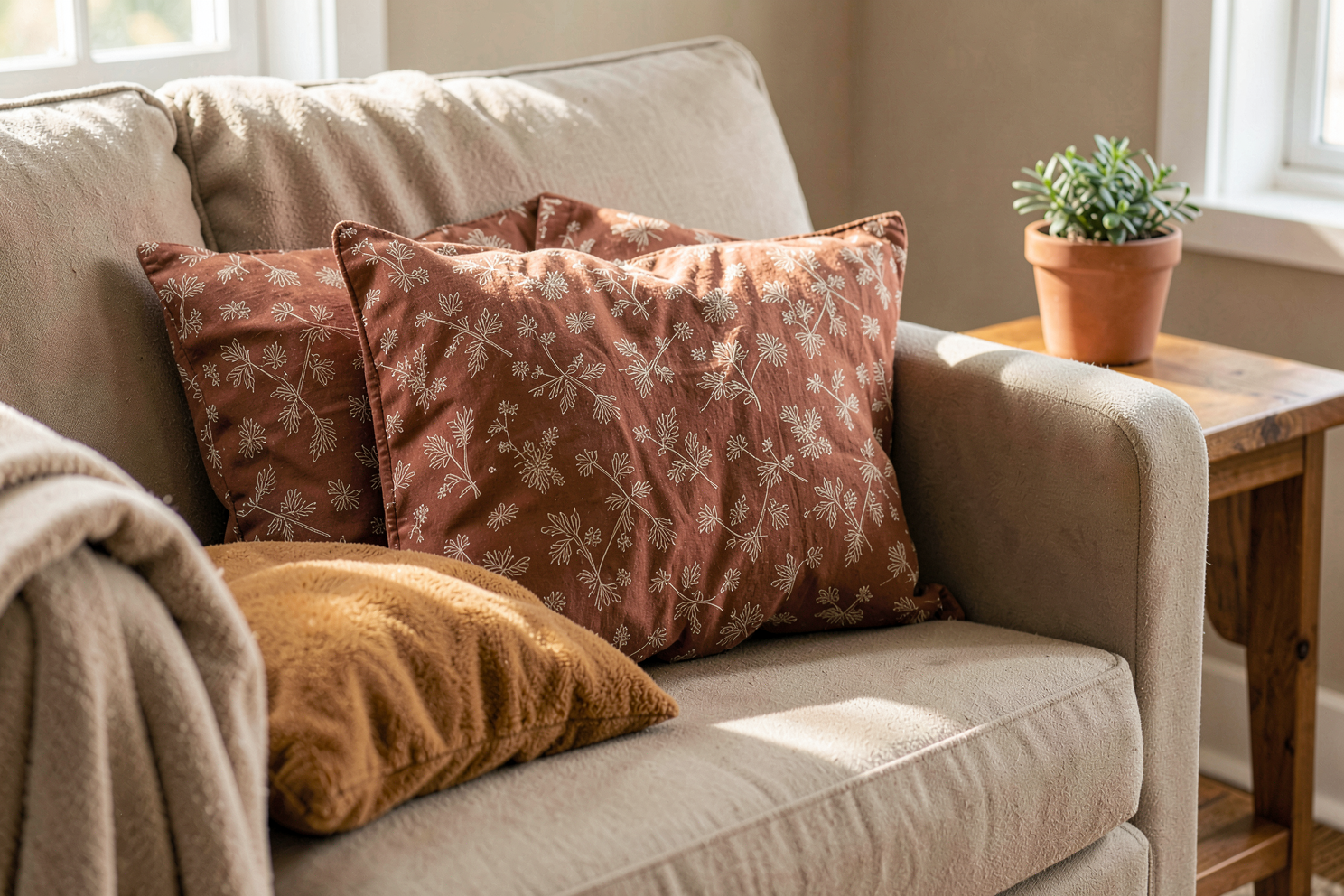
The two covers I use are both rust, but they're not the same rust, and that's on purpose. One is a flat rust with a boho pattern. One is a caramel-orange chenille. Same family, different texture and slightly different depth, which is what keeps it from looking like a matching set you bought in a bag.
Both come up constantly in the fall home decor category, and both have thousands of reviews behind them — Fancy Homi's rust boho covers and MIULEE's chenille covers. Search "fancy homi boho pillow covers" and "miulee chenille pillow covers" and you'll land on them. I'm not going to pretend I invented this pairing. I'm telling you it works and why.
How do you layer a solid and a patterned cover without it looking busy?
One pattern, one solid, and let the solid be the bigger pillow. That's the whole rule. If the patterned cover is on the larger pillow and the solid is small, the eye goes straight to the pattern and the solid looks like an afterthought.
My setup: an 18×18 patterned rust cover on the left, a 20×20 solid chenille on the right, and a small lumbar in front that I already owned. Two new covers, one old pillow. The 18-inch one is the Fancy Homi boho cover. The 20-inch is the MIULEE chenille, which is the one that actually does the warming — chenille has a pile to it, so it soaks up light instead of bouncing it back the way a flat cotton cover does.
One real drawback on the chenille: it sheds for the first week or two. Not badly, but if you have a black sofa or a dark throw underneath, you'll notice fuzz. It stops. Mine did after about ten days and two lint-roller passes.
What size pillow covers do you actually need?
Measure the insert, not the cover you're replacing, and go down one size for a full look. A 20×20 insert wants an 18×18 cover if you like a plump pillow, or a 20×20 cover if you like it flat and square.
This trips people up constantly. A cover the same size as the insert looks understuffed, because the cover has seams and the insert has to fill corners it can't quite reach. Most inserts are also a half-inch smaller than labeled. If your couch pillows came with the sofa, they're probably 18×18 and slightly flat already, in which case buy 18×18 covers and accept that they'll look relaxed rather than full.
Zipper position matters more than people say. A hidden zipper on the bottom edge is easier to stuff than one on the side, and it's less likely to catch on the couch frame when you're shoving the insert in. Both of these have bottom zippers. That's part of why I kept them.
The ten-minute swap, in order
Start with the pillows you already have on the sofa and pull the covers off all of them at once. Don't do one at a time — you'll end up with a half-swapped couch and lose momentum.
Then: bigger pillow gets the solid chenille. Smaller gets the boho pattern. If you have a third pillow, it stays in whatever neutral it already was, or it comes off entirely. Three rust pillows on one sofa is a lot. Two is the number.
Fluff the inserts by hand before you zip. Fold the insert in half, slide it in, unfold it inside the cover, then zip. This takes thirty seconds and saves you from the thing where one corner is empty and you can feel it every time you sit down.
Then step back and look at it from the doorway, not from three feet away. From three feet away everything looks fine. From the doorway you'll see whether the rust is actually warming the room or just sitting on the couch like a decoration.
Where do the old covers go in October?
Flat, in a bin, with the rest of the summer covers. This is the part that sold me on covers over new pillows in the first place. A pillow cover folds flat to about the size of a t-shirt. Four of them take up less space than one throw blanket.
I keep mine in a single [NEED: bin brand and size] in the hall closet, labeled by season. Not with a label maker — with a piece of masking tape and a Sharpie, because a label on a messy bin is still a messy bin, and my closet shelf is not a place I need to be fancy.
The inserts stay on the sofa year-round. Only the covers move. That's the whole storage story: two covers out, two covers in, ten minutes, twice a year.
What if rust is too much for your room?
Then go caramel instead, which is what the MIULEE chenille actually is — less red, more orange-brown. It's the softer version of the same idea and it works on the same sofas. The boho cover is the one that commits to rust. If you're unsure, buy the chenille first, live with it a week, and decide whether you want the second one.
The cheapest first step is one cover, not two. Ten dollars, one pillow, one week. If the room feels warmer when you walk in from the hallway, buy the second one. If it doesn't, you've learned something about your sofa for ten dollars instead of forty, and that's a better trade than a new sofa you didn't need.